 Intervention of the Month Intervention of the Month |
|
| A Case of Acute Myocardial Infarction in a Young Woman due to Congenital Coronary Artery Aneurysm |
Jum Suk Ko, MD, Doo Sun Sim, MD, Young Joon Hong, MD, PhD, Ju Han Kim, MD, PhD, Youngkeun Ahn, MD, PhD, FACC, FSCAI and Myung Ho Jeong, MD, PhD, FACC, FAHA, FESC, FSACI
The Heart Center of Chonnam National University Hospital, Gwangju, Korea
|
|
A 30-year-old woman without any risk factor of coronary artery disease presented with continuous chest pain that aggravated 1 hour before admission. Her initial EKG showed ST elevation in lead II, III, aVF. The levels of cardiac enzyme were elevated: CK 1924 U/L (35-172), CK-MB 91.8 U/L (2.3-9.5) and troponin-I 23.2 ng/mL (0-0.05).
Emergent CAG revealed thrombotic total occlusion in proximal RCA. After wiring into RCA, distal flow was restored. But we could see huge saccular aneurysm in mid-RCA filled with thrombi and multiple intracoronary thrombi over middle to distal RCA (Fig. 1). After abciximab infusion, we performed Thrombuster® aspiration device and removed large amount of thrombi (Fig. 2). But majority of thrombi were still remained in aneurismal sac and distal flow was decreased due to distal embolization. Thus we performed balloon angioplasty with 3.0 mm balloon multiple times. Final CAG showed improved distal flow to RCA (Fig. 3).
After PCI, we continued intensive medical therapy and evaluated for the cause of coronary artery aneurysm, such as Kawasaki disease. But no definite clue was found even after extensive screening.
Cardiac CT angiography was performed for the identification of more precise coronary artery morphology. It showed large aneurismal dilatation of proximal RCA with mixed plaque and ulceration (Fig. 4). Follow up coronary angiography was performed after 9 days of intensive medical treatment. In coronary angiography, thrombi in aneurysmal sac were markedly resolved compared with previous coronary angiogram (Fig. 5). IVUS findings revealed a huge aneurysm in the target lesion (Fig. 6)
A congenital aneurysm of coronary artery may be associated with thrombotic total occlusion and a rare cause of acute myocardial infarction in a young patient.
|
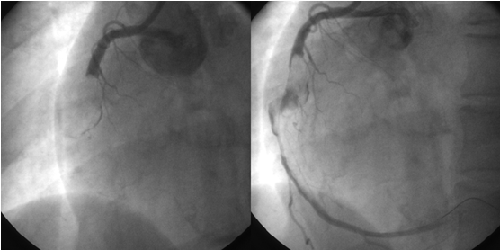 |
▲ Figure 1. A: Left anterior oblique view of the right coronary artery showing thrombotic total occlusion in proximal RCA. B: After passage of wire, distal flow was restored, but large coronary artery aneurysm was revealed.
|
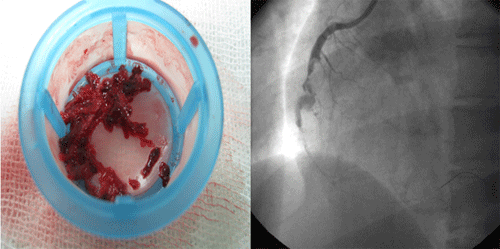 |
▲ Figure 2. A: Large amount of thrombi were removed with Thrombuster® aspiration device.B. There was large amount of remaining thrombi and distal embolization into distal RCA was observed.
|
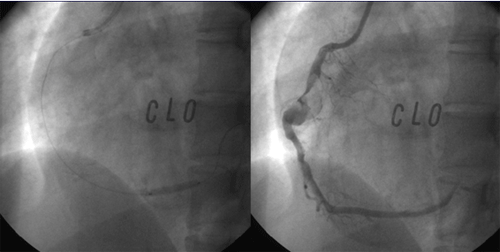 |
▲ Figure 3. A: PTCA was performed multiple inflations using 3.0 mm balloon over RCA. B: Final CAG showed improved distal RCA flow.
|
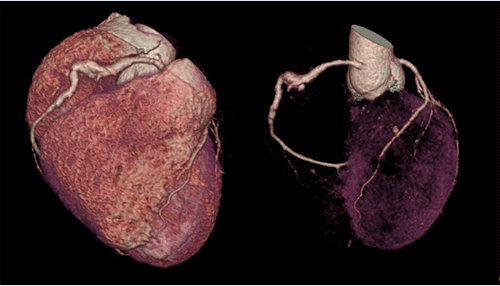 |
▲ Figure 4. Cardiac CT angiography demonstrated aneurismal dilatation of proximal RCA
|
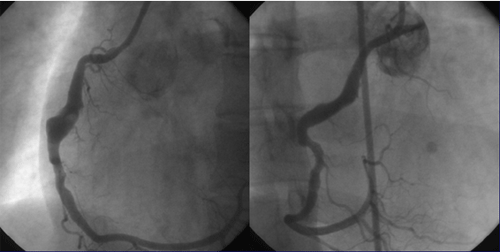 |
▲ Figure 5. Follow up coronary angiography after 9 days of intensive medical treatment showed resolution of thrombi.
|
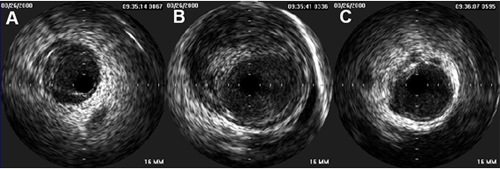 |
▲ Figure 6. Intravascular ultrasound findings of right coronary artery: (A) distal reference : diameter=5.5 mm, cross sectional area (CSA)=23.6 ㎟ (B) target site revealing huge aneurysm with thrombi : diameter=11.7 mm, CSA=97.3 ㎟ (C) proximal reference : diameter = 6.7 mm, CSA = 27.5 ㎟.
|
|
| |
위의 이달의 중재술을 보신 선생님들의 의견을 아래의 의견 쓰기에 의견을 남겨 주십시오.
선생님들의 다양한 의견을 받습니다.
|
![[의견쓰기]](/image/comment_btn.gif) |
Warning: include(/home/virtual/circulationadmin/new/info/comment_index.php) [function.include]: failed to open stream: No such file or directory in /home/virtual/circulationadmin/new/info/case/200809/case200809.htm on line 179
Warning: include() [function.include]: Failed opening '/home/virtual/circulationadmin/new/info/comment_index.php' for inclusion (include_path='.:/usr/local/php/lib/php') in /home/virtual/circulationadmin/new/info/case/200809/case200809.htm on line 179
|
|
|